Butane and propane are widely used for camping stoves. The question is which is better for cold weather camping. So keep reading, the answer is in the text.
There are at least two possible reasons why propane could be more suitable for cold weather camping:
- Lower boiling point.
- Better combustion with reduced oxygen level.
Below I give details about this.
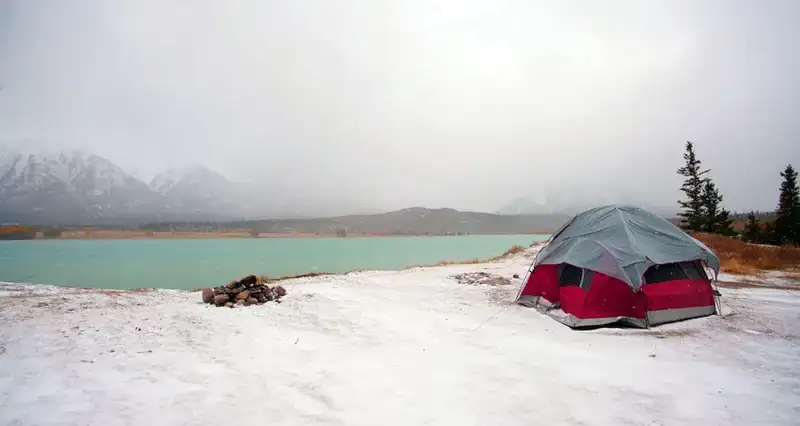
So why is propane better than butane in the winter?
The main reason is as follows. At normal pressure, propane C3H8 liquifies below its boiling point which is −44 °F (−42 °C). This means you will have it in a gas state in your tank in almost all camping conditions.
Now compare this with the boiling point of butane C4H10 which is 30 °F (-1 °C). This means that you will not have gas in your canister if you camp at temperatures that are below this value.
How do cold and altitude affect cooking on propane stoves? Why is propane better at high elevations?
There are at least two reasons.
1. Temperature effect
The temperature drops with altitude, so this is similar to winter conditions. There are online calculators that will give you a rough estimate.
Very roughly speaking, you can expect a change (decrease) of 5-6 °F per 1000 feet elevation increase. This is close to 10 °C drop per 1000 meters of increased elevation. The numbers are roughly half of these values if it is raining or snowing.
So, if your butane stove works in the valley, it may not work great at high elevations. The reason is explained in the previous section. This is why you would want to play safe and use a propane stove, it should do the work everywhere.
I am writing these lines in the summer period when, unfortunately, from what I hear, freezing temperatures in the Alps are pushed above 5000 meters. Some are convinced this is because of global warming.
In any case, there are no such high mountains in the area, so your butane stove might work everywhere. But in general, propane may be a better option if you go to high mountains.
2. Propane stoves may work better with reduced oxygen
Oxygen reduces with altitude, and the same holds for the air in general. Here are some numbers for the oxygen concentration with elevation:
- 0 meters: 21% of the total air.
- 914 m: 18.6% (drops to 89% of its sea level value).
- 2133 m: 16% (drops to 76% of its sea level value).
- 3000 m: 14.3% (drops to 68% of its sea level value)
- 4000 m: 12.7% (drops to 60% of its seal level value).
To understand why this may be important, let’s see the burning as a chemical reaction. In the case of propane, this is what you can find on Wikipedia, the first chemical reaction is propane burning in the case of sufficient oxygen level:

So combustion here may develop in two ways. In the first, carbon-monoxide CO is produced, and it requires 9/2 oxygen molecules per a propane molecule. In the second there is no CO, and only 2 oxygen molecules are required. So it is likely that you will have CO as a product.
From the same source you can see how burning looks in the case of butane:

This screenshot tells you that at higher elevation where oxygen is reduced you will always have carbon-monoxide CO as a collateral product in burning, and it takes 9 oxygen molecules in the process which is more than in the case of propane.
At high elevations, you will likely be cooking in the tent. So, as a whole, the butane combustion looks worse than propane combustion, this mainly because of the carbon-monoxide CO development, and more oxygen needed for the process.
So ventilate your tent during cooking, no matter which gas you use, and you will be fine. Oh yes, I know that many claim that you should never cook in a tent. My guess is that those have never really been in mountains and forced to prepare a meal there. A bit more you have in my separate text.
How about warm weather camping?
I think this should be obvious. Both propane and butane will do the job if you are at low elevations, and you can expect less CO produced in the combustion.
Is it better to cook with butane or propane?
In the context of this text, you might say propane is better. Though one should first define the meaning of ‘better’. If you can buy butane cheaper, then in my view this is better.
But why not using both? There are camping stoves that are designed to work with both types of canisters.
The Gas ONE Propane or Butane Stove GS-3400P is one great example, it is incredibly popular and also incredibly affordable. It comes with a built-in regulator that allows it to be used with both an 8 oz butane canister and a 16.4 oz propane tank.
In summary, a direct answer to the question from the title ‘Butane or Propane for Cold Weather’ would be it is propane. But this does not necessarily mean that butane would not do the job.
Thank you for reading. For more texts of this type please check under the category Camping here in the site. See in particular about options for sleeping on when you are in the camp.
This site is all about answering outdoor questions, so you might want to bookmark it and keep as a reference.
Let me know if you have questions or you think I have said something wrong in the text, there is a comment box below.
Leave a Reply