Descending a dry grass slope with serious inclination and exposure can be as dangerous as descending snow slopes. So the same technics should be used for self-arrest.
If you are in a situation to descend a steep dry grass slope, use your ice axe and crampons if you have them at hand. If not, use your trekking poles for balance and also to anchor your feet. But if you have no tools of any kind, traverse the slope and zig zag at a mild angle.

Why you should avoid descending down a pathless dry grass slope
This text is about ways of descending steep dry grassy slopes, but it is best not to do this. I know it may be temping to make such shortcuts, but sometimes it may be ‘shorter by going around’ as we say in my native language.
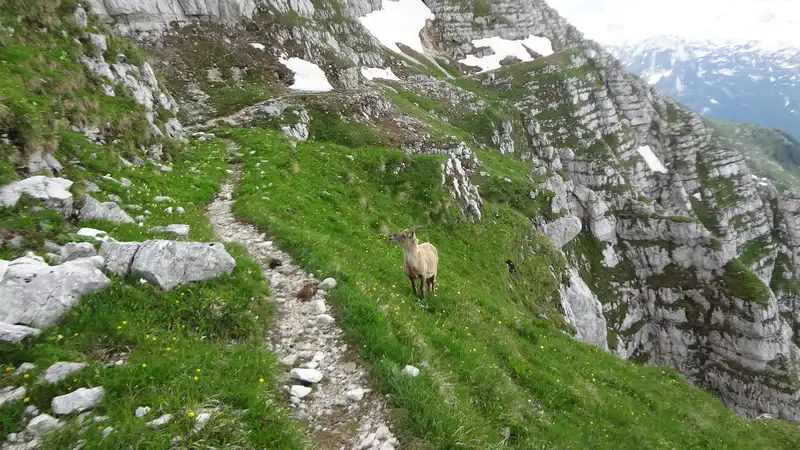
There may be rocks in the grass and if you fall and start sliding you can get seriously hurt. On the other hand, if you do not know what may be below such a nice grassy slope, you can get in trouble.
What if it ends up on a cliff? See the picture below from one of my tours in Italy. Is so, you will have to climb up again, and this may be hard. So it is better to play safe and follow an established descending path than taking a risk.
Using an ice axe and crampons for grass slopes
This can work only if you have such tools with you of course. In most cases this will probably not be the case. Why would you have an ice axe in such an environment?
Well, if you are descending from high mountains where you have used an ice axe on the snow or glacier, you can use it in the lower sections of the route as well. I have seen people taking shortcuts instead of following some zig-zagging descending paths, to save time or because they find the path boring.
So in such cases, it is best that you keep your ice axe in hands. You can use it as a walking stick and, if needed, you will then use it for self-arrest just like on the glacier above.
If this is what you do, make sure you keep the ice axe in the uphill hand, and its pick pointing to the rear.
If you have an ice axe, then it is likely that you will have crampons with you as well. Use them here, it is better than to take a risk. This holds in particular if the ground underneath the grass is frozen. I would say that crampons would be a must in this case.
Using trekking poles when descending steep grassy slopes
I normally always have trekking poles with me, and here is what I do in such situations. Using poles is good for stability and balance in any case, and this is even more so on a steep grassy and dry slope.
- If I descend by traversing, I try to press the down-hill side pole firmly into ground and then I put my foot next to it on the uphill-side regarding the pole’s position. In this case the pole is a sort of an anchor point and it prevents the foot from sliding down.
- The same technic I use if I descend directly. I step down by placing my feet in horizontal direction with the down-hill side pole anchored below the lower foot.
- But if you fall, the poles will make the things worse. So in my view it is best that pole straps are not around your hands. If you start sliding down the hill, poles will not be of help any longer. So it is better to drop them completely and have free hands and elbows to self-arrest somehow.
Descending without any tools
Well, in this case, it is best not to fall. So it is not advisable to take a risk, and use a path if it is available. If the ground is frozen this can be far more risky.
On such grassy slopes there may be some hardly visible traverse paths created by wild or domestic animals, so use them as much as you can.
• But in any case, traverse such places so that your direction is at a mild angle, zig-zag and change direction all the time. This is necessary because your down-hill leg will take all the weight, and the up-hill leg will be just for balance. So it is a must to change their roles as you zig-zag down the slope.
• Another way is similar to what I described in the case with poles. This means moving sidewise. So if you descend directly down the steep hill, step down with your foot so that it remains perpendicular to the direction, i.e., the foot is placed horizontally.
Make sure to cut firmly into the ground with your sole or try to find a good hold for the foot. Then move your upper leg towards the lower while keeping its foot also in the horizontal direction. Repeat this pattern as you descend.
In summary, it may be risky and dangerous descending down a pathless dry grass slope, and I have pointed out some reasons. So it is best not to do this, but if you have to, apply some of the tools and technics mentioned above.
Perhaps I have missed saying something important, and if so, please let me know, there is a comment box below.
Check around in this site for more texts of this type, in particular in the category Mountaineering. My text about strategy to ascend a steep scree slope may be of interest for you. Thank you for reading and have a nice day.
Leave a Reply