We all know that it is hard to walk uphill. But how exactly does walking uphill make us tired and why this happens? Here you can read some details about this.
There are several major factors that play a role when you walk uphill and that make us tired:
- Extra work against gravity.
- Additional muscles in action.
- Elevation.
The words extra and additional here mean that we work more when we walk uphill than when we walk on a flat ground, and some less frequently used muscles are engaged. Elevation implies less oxygen in the air so you are more out of breath than when you are on a lower ground.
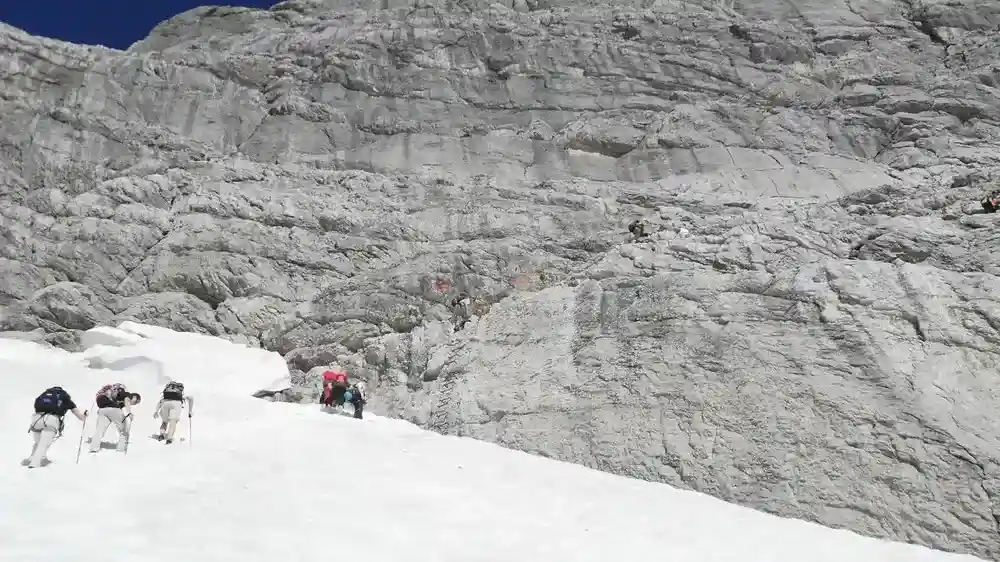
Why do we get so fatigued walking uphill and not really at all walking on level ground or downhill?
The question in this subtitle is an actual question that people asked. I use it as it is, but it is appropriate to stress that it is not completely accurate. Namely, we do get fatigued also when we walk on a level ground or downhill.
Extra work against gravity
When we walk on a flat ground, we use muscles to keep us upright again gravity. This is what we are used to in out daily life. Our muscles are trained for this and we do this more or less even without noticing it.
But when you walk uphill, an extra work is required simply because we have to lift our body with every step. From this you also understand that being overweight will not make things easier.

Now compare this with walking downhill. In this case, with every step we fall because of gravity. So we use muscles to stabilize our movement. This too requires some energy, and it may add stress on our knees, but physically this is much easier than going uphill.
I discussed this in my other texts where I analyzed the fact that it is easier to fall when walking downhill and why it is easier to go downhill. Even for a downhill walk, overweight is detrimental as this will make extra stress on your knees.
Walking uphill against gravity requires an increased supply of blood and oxygen because lungs and heart work more than usual. Your heart rate may increase drastically and as a result you will feel out of breath.
How to deal with this?
- It is best to slow down.
- Walk at a mild angle, switchback style.
- Make shorter steps.
- Use trekking poles.

If you add into the picture the extra weight from your backpack on your shoulders, you understand even better why it is hard walking uphill.
This is why it is essential that its weight is on your hips and not on your shoulders. Ideally you should have no weight on shoulders at all.
Additional muscles in action when you walk uphill
Normally all muscles are involved when we walk, but those that work more on a flat ground are always in use and we do not feel soreness in our typical daily activity.
An uphill walk is harder and more stress is on a group of muscles on the lower parts of our legs, so if you are not used to this, you will feel this the day after. This is what happens all the time to me when I go to the mountains. First couple of days are indeed painful.
Can you train for this? I would say yes up to some extent. Treadmill training allows you to set a gradient so your feet are in a position similar to walking uphill. This gradient can also be programmed to change gradually, so this can certainly help.
But in a real hike, the ground changes all the time in every possible way and nothing can prepare you completely. It is not only about gradient, it is about foot positions on a uneven ground, obstacles on the route which you have to pass, to jump sometimes, to descent short distances and then walk up again, etc.
Elevation effects
Everybody knows that air density decreases with elevation. On the other hand, air is a mixture of gasses where oxygen is essential for humans. So oxygen concentration also decreases with altitude, you can find all the details about this on Wikipedia.
Oxygen is our fuel, and you have it around 21% at the sea level. There are online calculators that will help you to know how much of it you have at certain elevations.
At 5500 meters of elevation you can expect 50% of the sea level value, and at the summit of Everest you will have only 30% of the sea level value. Now you can appreciate Messner even more for climbing all 8000ers without oxygen.
According to a study, this oxygen decrease affects lungs, heart, brain, and blood.
Lungs: Normally, carbon dioxide is the main stimulus to ventilation but altitude hypoxia increases ventilation. There is also pulmonary circulation and related hypoxic pulmonary vasoconstriction with an unclear role in our body.
At high altitudes, it is shown that the alveolar-arterial difference for oxygen is higher than would be predicted from the measured ventilation-perfusion inequality.
Heart: You will experience an increased heart rate and decreased stroke volume for a given level of work.
Brain: Our brain is affected by hypoxia and this leads to poor judgment and accidents. There are reports about enduring abnormalities of cognitive function and ability to perform fast repetitive movements long after you descend to normal altitudes.
Blood: There is a clear evidence of an increased viscosity of the blood and it is coupled with increased coagulability. This increases the risk of stroke and venous thromboembolism.
In this video you will see some very useful suggestions, I fully agree with everything she is saying, have a look:
Summary
So these are some of the reasons of how and why walking uphill make us tired. I might have missed mentioning something important so let me know, there is a comment box below.
Look around for more texts of this type, this site is all about answering outdoors questions. Read also my another text about complaints of people who have issues with a running nose in the mountains.
Bookmark it and keep as a reference. Thank you for reading and have a nice day.
Leave a Reply