I just came from my usual evening walk, and this happened to be in the worst possible weather situation with wet snow and rain combined, with completely wet and muddy ground. So how did my clothing and boots perform?
After several decades of hiking and mountaineering, I am pretty sure in saying that equipment with various types of waterproof and breathable membranes is only partly waterproof.
I am not going to mention here any outdoor equipment brand. This is not the point of the text.
I do not want to write anything negative about equipment from brands which I have been using for years. I love their products and I have high respect for what they are doing. By using their products, I was able to get to places where I would not manage without them.
Instead, I want to say something about reality and to express my thoughts about this topic which has been on my mind for a long time, but I was reluctant to write about it.
This is about things like hiking and backpacking boots and shoes, rain shell jackets, rain pants, and gloves. These items I always have with me when I go to the mountains. Boots or shoes are on my feet, and the rest, if not used, is in my backpack.
So this basic set of a waterproof layer for the whole body is something without which I simply do not go, no matter the current weather and weather forecast.
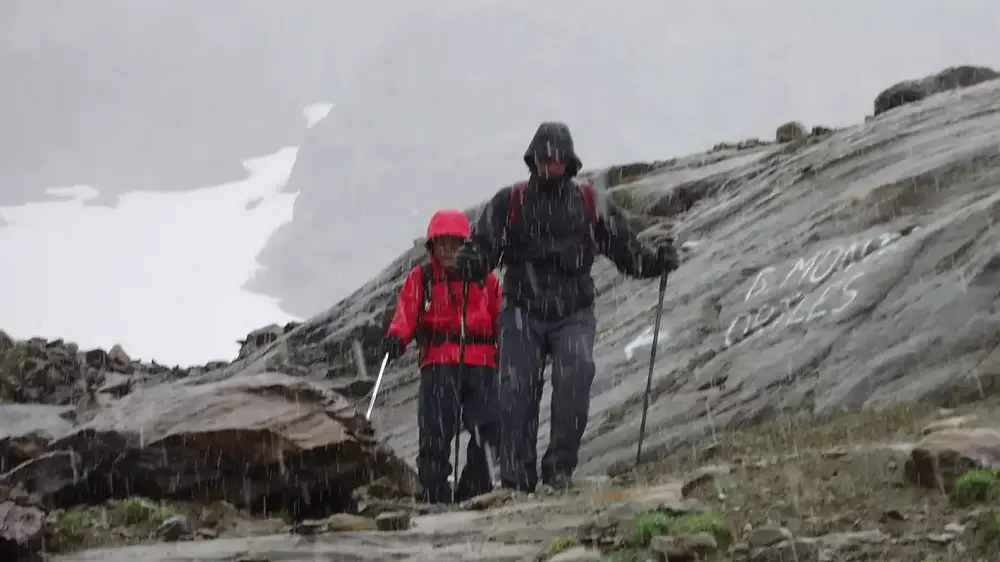
The picture below shows one example of what you can have in a day high in the Alps. The top picture above is from the same tour. More in my text about Bivacco Ortles.

Where things go wrong with waterproof equipment?
Actually, I am not sure about the answer to this question.
There are some videos around by membrane manufacturers, and what they show is quite impressive. So here is what you can see in an actual video:
Put a glove made purely from such a membrane on a wet hand, no fabric at all. Then put the hand with the glove on into cold water. After some time, take the hand out and remove the glove. The result is a dry hand.
What happened? The hand was wet, and it dried under the membrane glove because of the body warmth. The vapor escaped through the membrane into the surrounding water! This is because the membrane is waterproof but breathable.
Now, isn’t this impressive? Of course it is. I am also confident it is true, this is about a globally known brand. The experiment nicely demonstrates the great features of a membrane.
Reality check: examples with boots & shoes
When I buy new boots or shoes, I always do a submerge test. Simply put the boot into the water and keep it there for up to 4-5 minutes.
What I usually notice is that the boot does not even get wet. This is because of some water-repellent chemicals that are generously sprayed on the boot from outside.
So naturally, such boots or shoes usually pass the submerge test, there is no water inside. But after using such boots for some time, like in the case of my today’s evening walk, I realize that the boots are not really waterproof.
When I came home I could see some areas on my socks where they were wet. The boots are with the membrane described in the experiment above.
The question is why they are not waterproof? I think I cannot know unless I decide to destroy them and to see what is inside. I do not know how the membrane layer is attached to the boots shell from inside.
My guess is that there may be some stitching that is not properly taped, or not taped at all. Or the membrane in time simply develops some cracks where water penetrates.
In any case, I would say that such boots and shoes are indeed waterproof for as long as they have those chemicals on the surface. In time these chemicals wear off.
Yes, I know it is advisable to re-apply it, there are some tutorials around on how to do this. But this is for water beading, isn’t it? I am talking here about boots not being waterproof.
So what remains is the external fabric and the membrane layer inside. Well, it turns out that those do not keep water out for sure.
How about waterproof clothing (jackets, pants, gloves)?
In short, the result is the same. In this case I can actually see that the inner surface of the jacket is wet. Some of my jackets have a free-hanging mesh as an inner layer and this separates the wet fabric from the underlayers, so it is bearable.
It is much worse with pockets where water gets in most jackets, and then from there, it gets into my underwear.
Even if I do not see water passing through the fabric, there are always zippers where it will pass. Yes, I know that there are waterproof zippers, and I also know that there are flaps on zippers, from inside and from outside, etc., etc. I know such stuff, have all types of it. But water still gets in and I get wet.
And no, it is not about sweating and vapor accumulating from inside. I am able to notice the difference, thank you for reminding me.
With pants the situation is far worse. I guess this is because of the rain water that funnels from the jacket and then it finds its way through the material of the pants, through vents, pockets, and around snap buttons. The same story is with “waterproof” gloves.
Using plastic as an alternative?
Yes, plastic works. When I use my plastic poncho or some cheap plastic pants, I am safe from the rain.
But wait, I become wet from inside. This material is not breathable, so vapor from sweating cannot escape, and I am wet again.
Any other alternative?
Sure there is. Have you ever heard about something cold umbrella? This primitive thing works much better than most of those advanced and expensive items. But in windy conditions, it is useless.
So I would say it is best to use it combined with some “waterproof” membrane based clothing. As for boots, at least for some simple walks, good old rubber stuff has no alternative.
But you know what, I have decided to show you the video mentioned above, have a look:
For more texts of this type please check in the category Trail Gear. Thank you for reading. Let me know what you think, there is a comment box below. Bookmark this site and keep it as a reference, you will always have new texts added here.
Leave a Reply